
Why Your Hotel's Emails Land in Spam — and How to Fix It
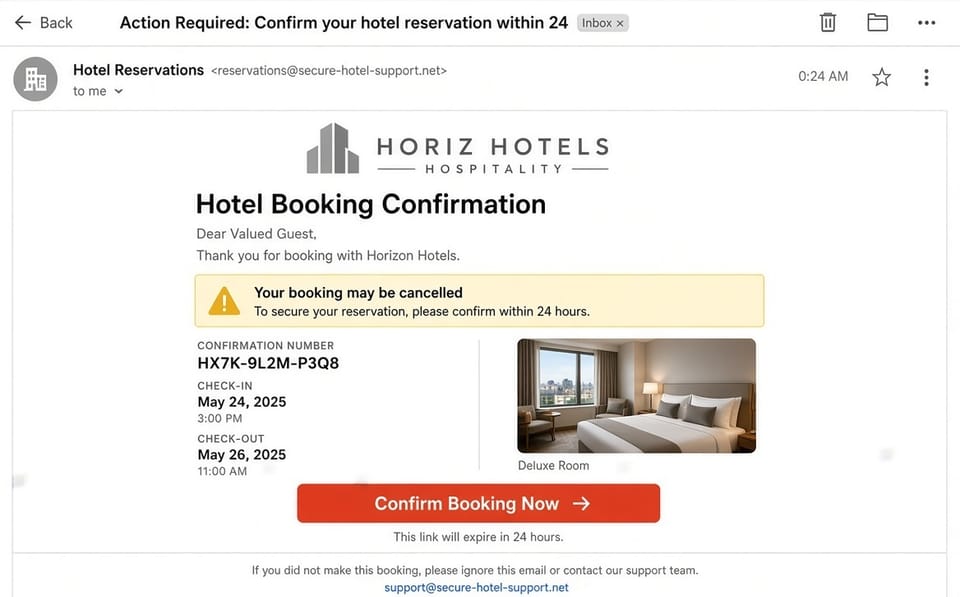
You send the booking confirmation. The guest says they never received it.
You send a "we miss you" offer to 4,000 past guests and watch the open rate crawl to 11%. You assume email is dying, or that guests are simply too busy.
The likelier explanation is that a good share of those emails never reached the inbox at all. Gmail, Outlook and Apple Mail quietly routed them to spam or promotions, where nobody will ever look. The guest then searches your hotel name, clicks the first result — often an online travel agency — and books there instead.
This guide explains, in plain English, why hotel emails get filtered, which emails matter most, and what a properly configured email setup looks like.
What this guide covers
- The guest emails that actually get opened
- Why transactional email outperforms marketing email by a wide margin
- The real reasons hotel emails land in spam
- What "sent over SMTP" means, and why it matters to your hotel
- The India-specific details guests expect by email
- A 12-point audit you can run this week
1. The emails your guests actually want
Email is not one channel. It is at least eight different messages, and guests treat them very differently.
Booking confirmation. Sent immediately after the reservation. Must include the confirmation number, guest name, arrival and departure dates, room type and rate, what is included, payment details, and the cancellation policy. This is the single most-read email you will ever send.
Payment receipt or tax invoice. Guests need this for expense claims and GST filing. A clean PDF invoice attached to a polite email saves your front desk from a dozen follow-up calls.
Pre-arrival email. Sent two to three days before check-in. Directions, parking, check-in time, breakfast timings, and a request for anything you need in advance. This is also the best moment to offer an airport pickup or an upgrade.
Check-in reminder. Sent on the morning of arrival. Short, practical, with the address and a one-tap link for directions.
In-stay messages. Restaurant timings, spa slots, event information. These are optional, and should be genuinely useful or skipped.
Checkout and folio. The bill, clearly laid out, sent before the guest reaches the desk.
Post-stay review request. Sent 24 to 48 hours after departure, while the stay is still fresh.
Win-back and seasonal offers. Sent to past guests before your low season. Valuable, but only to guests who agreed to hear from you.
Two rules apply to all of them. Write the subject line as if it is the whole email, because it decides whether anything else is read. And make every email render properly on a phone — more than half of hotel bookings happen on mobile devices.
2. Transactional email is your best-performing channel
Here is the part most hotels underuse. Emails that a guest expects — confirmations, receipts, pre-arrival details — are read far more than anything promotional.
Industry benchmarks for hotel email consistently show booking confirmations and booking-modification emails achieving around 72% open rates and roughly 25% click-through rates. One-time promotional campaigns, by contrast, sit around 32% open rates with click-through in the low single digits. Automated, behaviour-triggered campaigns land in between, around 56% open rates, because they arrive at a moment the guest cares about.
That gap matters for revenue, not just vanity metrics. Adding a well-placed upsell to a confirmation email generates tens of dollars per booking on average — and the same in pre-arrival emails — because the guest has just committed and is receptive. Food and beverage leads upsell categories, followed by early and late checkout.
The lesson: your highest-engagement emails are not your campaigns. They are the ones you are already sending. Most hotels simply leave them plain.
3. Why your emails land in spam
Filtering is not random. Mailbox providers judge every message on two things: whether it is genuinely from you, and whether recipients want it. Six problems account for most hotel failures.
Your booking confirmation shares infrastructure with your marketing blasts. This is the biggest and most common issue in hospitality. A promotional campaign sent to a list that never opted in generates complaints. Those complaints damage the reputation of the domain you are sending from — and the next batch of booking confirmations goes out on the same damaged reputation. Your most important email suffers because of your least important one.
Your domain is not authenticated. Gmail and Yahoo now effectively require bulk senders to authenticate. If your sending domain is not properly configured, your mail is at high risk of being blocked or sent to spam.
Your list has rotted. Hard bounces mean the address does not exist. Keep mailing them and you look exactly like a spammer who bought a list. Long-unengaged contacts — nobody has opened anything in a year — drag your reputation down with every send.
Your seasonal volume spikes. Resorts and destination hotels often send almost nothing in low season, then ramp hard before peak booking. To a mailbox provider, going from near-zero to high volume overnight looks like the behaviour of a compromised domain. Volume has to be warmed up gradually, over four to six weeks, before peak campaigns.
Your emails look like marketing even when they are not. A single large image with no text, links pointing to unfamiliar domains, or a subject line that reads like an advertisement can trip filters on an otherwise legitimate confirmation.
You do not monitor delivery at all. Most hotels can tell you their open rate. Very few can tell you whether their booking confirmations were actually delivered yesterday. Without that number, you are guessing.
4. What "sent over SMTP" actually means
You may have heard your provider mention SMTP. In plain terms, SMTP is the standard way one mail server hands a message to another. It is the postal service of email — the rules that govern how a message is passed along, not what the message says.
Why should a hotelier care? Because of three practical consequences.
You can send from your own domain. When mail goes out through a properly configured server under your hotel's own domain, the guest sees your name, your branding, and a consistent identity. Mail sent from a generic shared domain often authenticates technically but still looks unfamiliar — and unfamiliar gets filtered.
You can keep transactional and marketing mail on separate streams. A correct setup sends booking confirmations, receipts and pre-arrival details on one stream, and promotional campaigns on another. A complaint spike on a promotional send can no longer harm the delivery of a booking confirmation. This single separation fixes the most common deliverability problem in hospitality.
You can see exactly what is happening. With proper sending infrastructure you can monitor delivery rates per stream, spot a failing batch immediately, and act before guests start calling the front desk. A practical alert threshold: if booking confirmation delivery drops below 98%, something is wrong and needs attention the same day.
The three technical records that make this work are worth knowing by name, because you will need to check them with whoever manages your domain.
- SPF is the list of servers allowed to send email on your behalf — an approved vendor list. Every service that sends mail as your hotel must be on it.
- DKIM adds a signature that proves the message genuinely came from you and was not altered in transit.
- DMARC is the policy that tells inbox providers what to do with mail claiming to be from you that fails those checks, and sends you reports showing who is actually sending as your domain.
If those three are correct, your emails are far more likely to land where they should. If any is missing, no amount of good content will save you.
5. The details Indian guests expect by email
Indian hotel guests have specific expectations that email handles better than any other channel.
A proper GST invoice. Business travellers need it, and they need it quickly. A clear tax invoice attached to the checkout email removes friction and reduces requests to the front desk.
Payment receipts. UPI, card and prepaid bookings should all generate an automatic receipt. Guests expect confirmation that money has moved, without having to ask.
Clear cancellation and refund terms. In the confirmation, not buried in the website. Stating them plainly reduces disputes later.
Consent that stands up. Transactional emails — confirmations, receipts, stay-related details — are expected and necessary. Promotional emails require the guest's agreement. Take consent at booking with a clear opt-in, keep a record of it, and honour opt-outs immediately.
Mobile-first design. Most bookings happen on a phone, and most emails are first read on one. If your confirmation requires pinching and zooming, it will not be read properly.
Email and WhatsApp work well together rather than competing. Use email for documents, invoices and anything the guest will need to keep or forward. Use WhatsApp for quick questions and time-sensitive updates.
6. A 12-point email audit
Work through this once. Most hotels find two or three real problems in the first pass.
- List every service that sends email as your hotel: booking engine, PMS, newsletter tool, reservations inbox, review platform.
- Confirm each one is authorised in your SPF record.
- Confirm DKIM is enabled and verified for every one of those services.
- Confirm a DMARC record exists, and that its reports go to an inbox somebody actually reads.
- Check whether booking confirmations and marketing campaigns send from the same domain. If they do, plan to separate them.
- Look at your hard bounce rate. Anything above about 1.5% means the list needs cleaning.
- Look at your spam complaint rate. Meaningful complaints are an emergency, not a statistic.
- Remove hard bounces permanently, and stop mailing contacts who have not engaged in a year.
- Check that promotional opt-in is captured separately at booking, with a record.
- Read your own booking confirmation on a phone, as a guest would.
- Send test emails to a Gmail, an Outlook and an Apple Mail address, and see where each lands.
- Set a daily alert for booking confirmation delivery rate, so a failure is noticed the same day rather than at the front desk.
7. Mistakes that quietly cost you bookings
- Sending promotional mail to every guest who ever booked. They did not consent to marketing. This is the fastest way to hurt the delivery of your confirmations.
- Treating the confirmation email as a receipt and nothing more. It is your highest-engagement message. Say what is included, what happens next, and how to reach you.
- Buying or scraping email lists. It damages your sender reputation permanently, and it does not work.
- Ignoring Apple's privacy changes. Apple Mail now opens emails on the recipient's behalf, which inflates open rates. Judge campaigns on clicks and bookings instead.
- Assuming a high open rate means bookings. Deliverability gets you into the inbox. The offer and the booking page still have to do the rest.
Frequently asked questions
Why do guests say they never received the booking confirmation?
Usually because it was filtered, not because it was not sent. Check your delivery rate, your domain authentication and whether the confirmation is being sent from the same stream as your marketing email. A guest searching their spam folder for a confirmation is a deliverability problem, not a guest problem.
What is SMTP, and do I need to understand it?
SMTP is the standard protocol mail servers use to pass messages to each other. You do not need to administer it yourself, but you do need to know that sending through properly configured infrastructure — from your own domain, with transactional and marketing mail separated — is what decides whether your emails reach the inbox.
What are SPF, DKIM and DMARC in simple terms?
SPF is the approved list of servers allowed to send mail as your hotel. DKIM is a signature proving the message is genuinely yours and unaltered. DMARC is the policy telling inbox providers what to do with mail that fails those checks, plus the reports that show who is sending as your domain.
Should booking confirmations and marketing emails come from the same place?
No. Keep them on separate sending streams. A complaint spike on a promotional campaign should never be able to affect the delivery of a booking confirmation.
How often should we email past guests?
Only when you have something genuinely relevant and only to those who agreed to hear from you. Segmented sends to smaller groups consistently outperform large blasts, and mass sends actively damage your sender reputation.
Does email still matter when WhatsApp exists?
Yes, for different jobs. Guests want documents — invoices, confirmations, receipts — in email where they can find and forward them. They want quick answers on WhatsApp. Hotels that run both well keep the guest informed without overwhelming them.
Where to start
The most valuable thing you can fix this month is not your next campaign. It is making sure the emails you already send — confirmations, invoices, pre-arrival details — actually arrive.
TravelMez includes an automated email and notification system alongside our hotel websites, direct booking engines and cloud PMS. Confirmations, payment receipts, check-in reminders, checkout folios and post-stay messages are sent automatically from your own domain, so every guest hears from the hotel they booked — not a stranger's domain that filters treat with suspicion.
Two things you can do this week:
- Ask whoever manages your domain to confirm that SPF, DKIM and DMARC are configured for every service that sends email as your hotel.
- Book a room on your own website, using your personal email address, and see whether the confirmation arrives in your inbox or your spam folder.
If you would like a second opinion on how your guest emails are performing, visithttps://travelmez.comto request a hotel technology consultation. We will look at what you are sending, what is reaching guests, and tell you honestly which fix would help most.